We need the Law of Cosines because it tells us the information of a non-right triangle for a SAS triangle, or a triangle that gives us two sides and the included angle, and a SSS triangle or a triangle that gives us all three sides. Lets take a look at the triangle above, we have cut it in half and we get two right triangles and we want to find the value of side a. If we imagine the triangle on a coordinate plane, we can use the distance formula to solve for side a. The distance formula of course asks for the coordinates of the two endpoints of whatever it is you are trying to find the actual distance of. In this case we need to find the coordinates of B and C.
This actually shows the Pythagorean part of the derivation but we find the coordinates easily. Here we have c sin A squared and b - cos A squared because we only want that specific side when we will be using the Pythagorean Theorem (remember we can do this because we cut the triangle into two right triangles). If you wondered where are the coordinates, they are right there, its just that when we are on the coordinate plane, we are on the x-axis, so we really only care about the x value. We get the value of h from cSin a and the value of the section of b we want with b - cosA. Once we finish the math we get a value in parentheses that is sin squared A + cos squared A which equals to 1 so we can get rid of it. The final answer is what we use in the Law of Cosines.
Still confused? Watch this video for extra help.
4. Area Formula of an Oblique Triangle
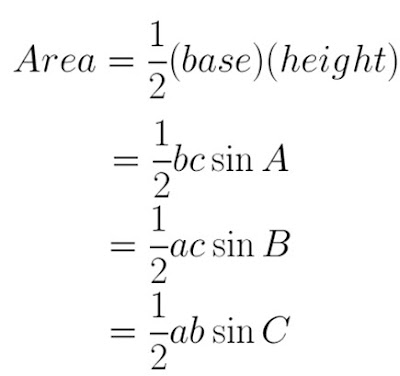
The area of an oblique triangle is derived using trig functions and is drawn in a way that has one right triangle to make things a bit easier.
The area of a triangle as we all know is half its base times its height. When we use trig functions on the triangle on the left, we know that h = asinC because sinC = h/a. Keep in mind that the h will not be automatically drawn on any oblique triangles, we are just imagining the line to help us derive.The same goes for the triangle on the right but this time we use sinA = h/c and we move around the formula as needed. So now that we have the value of our h we can just substitute it into our regular formula and we get the following three formulas depending on what we have.
Notice that we substitute the height correctly by what they give us, so we need to pay special attention to what sides they give us in order to find the area.
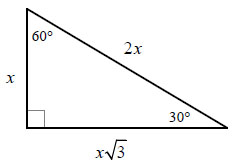
To follow this image, view from right to left starting with what we were given first, an equilateral triangle with sides all equaling 1. Since it's an equilateral triangle, we will also have all angles equal to 60°. We cut the triangle down it's altitude because we want to have right triangles, in this case we get two of them but notice that one of the angles is now 30°, one of the sides is unknown, which happens to be the longer leg, and the shorter leg has been halved to 1/2.
To find the unknown side, we use the Pythagorean theorembut instead of using 1/2 we should double it so that we can have an easier time solving for it. We can do this because the triangle would still hold proportionate to a 30-60-90 as long as we double the other known side. We find the unknown side to be √3 and we set up our values into a special ratio for our special right triangle by putting n into the values so it can fit any 30-60-90 triangle as long as it fits the ratio.
2. 45-45-90
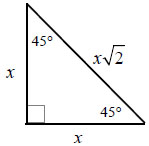
Once again start with what we were given, this time a square with all sides equaling 1 and the angles each being 90°. We cut across this square to get our two right triangles, both having sides equaling 1 and having two 45° angles but now their hypotenuse has an unknown value. To find this unknown value you use the Pythagorean Theorem and you get √2. We have our final values and turn them into the special ratio for our 45-45-90 triangle by using n as a variable for any other special right triangles we may have to make sure the sides correspond to the ratio of 1, 1, and radical 2.
Inquiry Activity Reflection
1. Something I never noticed before about special right triangles is that they can be constructed from other shapes. To go into more detail I just thought they were weird triangles that had special rules attached to them but they actually appear in a lot of places.
2. Being able to derive these patterns myself aids in my learning because it gives me an idea of where these special rules come from and how they come together.
Before we begin to solve the special right triangle section of the unit circle, we must first follow the special right triangle rules as shown in the first picture. For this triangle, we start from the 30° angle and move from there. So the hypotenuse will stay the same as the 2 value, but the side opposite from our angle will be the 1 value because that is what is next to the x in our rule and the side that will be horizontal will have a set radical 3 value. We will also pretend the triangle is on a coordinate grid where the horizontal side is basically the y value and the vertical side is the x while the hypotenuse will take the radius value.
Now we can solve for this special right triangle with the parameters given. Since we are solving for a section of a unit circle, the radius always has to be one so there is one value given. To get to the value, we must divide the hypotenuse by 2 and do the same for each side. The y value becomes 1/2 and the x value becomes radical 3 over 2. The coordinates are easy to plot if you are still imagining a coordinate grid and are shown next to the corners of the triangle, with our origin starting at the 30°.
What we did previously will now be used to solve for this triangle. Now we have a 45 45 90 right triangle and we are starting from one of the 45° angles. Use the new set of special right triangle rule for this triangle and now we have to divide the hypotenuse by radical 2 to get our desired one value. Do that division for each side and now You have your x and y values as labelled in the right picture. Remember you cannot have a radical in the denominator so make sure you multiply by a radical over radical value to get rid of that radical. This time the ordered pairs are circled a midst all the work that is shown.
Truth be told the resourceful learner would just use the values solved for in the 30° triangle and switch them accordingly. But an explanation will be provided for the slower learners in the crowd. We use the same rule for our 60° triangle as the first one because it is apart of the same 30,60,90 triangle, and we still divide the hypotenuse by 2 to get our desired 1 value and do the same thing for the other sides. But now we must switch the x and y values we had because the angle we are starting from is different. We must also pay careful attention to our coordinates because our values have been switched. The coordinates are circled again and the x and y values have been changed so make sure you read carefully.
4. How does this help you derive the unit circle?
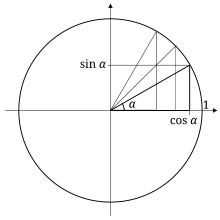
This triangle activity helped me figure out why the coordinates change as I go through a unit circle. It makes perfect sense now that I look at it, the unit circle is just composed of a bunch of triangles. The coordinate we care about is the one that is connected to the y value and the hypotenuse, that is where I figured out why we have such crazy numbers like radical 3 over 2. It also helps me remember what coordinates go where for the unit circle because now I look at the unit circle like a grid where the radius is always 1. Here is a picture I found that better illustrates the idea that these triangles fit in the unit circle.
5. What quadrant does the triangle drawn in this activity lie in? How do the values change if you draw the triangles in Quadrant II, III, or IV? Re-draw the three triangles, but this time put one of the triangles in Quadrant II, one in Quadrant III, and one in Quadrant IV. Label them as you did in the activity and describe the changes that occur.
The triangles drawn in this activity belong in quadrant I because we start from the origin and go right on the x axis and our triangle points upwards into quadrant I. The values change signs whenever we move them into other quadrants, but as long as we keep the same angle, the values will stay the same. For example the x and y value will be negative in quadrant III and only the y value will be negative in quadrant IV. Lets draw a each angle in a different spot to see these differences.
Here we have a 45° angle in quadrant II. The only thing that changes here is the sign for the x value and you can clearly see that the coordinate changes accordingly. The x and y value are labelled here to show you the difference.
Here we have a 30° angle in quadrant III. This time both the x and the y value change signs as represented in the image, The coordinate value changes signs while in this quadrant as well.
Here we have a 60° angle in quadrant IV and this time only the y value changes signs as seen in the labels above.
Inquiry Activity Reflection
The coolest thing I learned from this activity was how the unit circle changes values according to rules for a triangle. I have always wondered about the similarity between triangles and circle when eating a pizza but I've never really put too much thought into it.
This activity will help me in this unit because simply put, it will make filling in the unit circle much easier. Although I still like memorizing it a lot more than this.
Something I never realized before about special right triangles and the unit circle is how closely related they are to each other. Special right triangles are the reason we have such wonky numbers in our unit circle when we are filling out the coordinates.
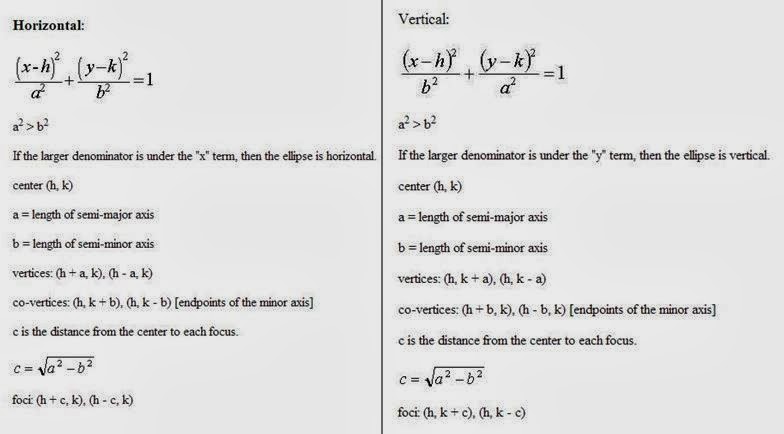
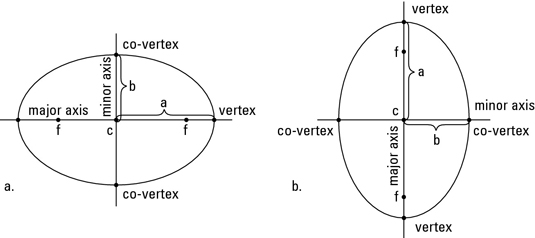
Graphically: Ellipse is an oval-shaped graph that has a major solid axis and a dotted minor axis. There is a focus graphed inside the ellipse and the center lies, obviously, in the center. Refer to the picture to figure out whether the ellipse will be horizontal or vertical. Points are also graphed on the endpoints of both axis.
Key Features:
http://media.wiley.com/Lux/94/219994.image1.jpgHere are all the key features of an ellipse. The center is not listed here but it is obviously the center and is found by the simple h.k rule from the equation, just take the h,k value and the opposite signs of those numbers are your center. The way you find the vertex is taking the square root of the bigger value or the "a" value and adding it and subtracting it either the h or k value whether its horizontal or vertical, view the previous image to better understand. The minor axis is found the same way but with the smaller "b" value. Both of these are found as the denominators and have axis that cross through them all the way to the center. The axis that crosses the vertex is usually solid and is called the major axis. The one that crosses the co-vertex is called the minor axis and is usually dotted. For more information visit http://www.clausentech.com/lchs/dclausen/algebra2/ellipses.htm .
Foci and Eccentricity: The foci are found by finding the c value through the equation a^2-b^2=c^2 where a must be greater than b. The value of c is then added and subtracted to either the h or k value in the same way the a value was added and subtracted. Foci dictate how circular the ellipse is, if it is closer to the center then it is more circular. The eccentricity or the value of c/a will always be less than one for an ellipse.
Further Help on Graphing an Ellipse:
3. Real World Application: Probably the most common occurence of ellipses is in space. The way gravity works makes orbit travel not in a perfect circle, but in a fixed ellipse.
(http://britton.disted.camosun.bc.ca/elliorbit.GIF)
One perfect example of this fixed path is Halley's Comet, which was discovered by Edmund Halley. "Halley's Comet takes about 76 years to travel abound our sun. Edmund Halley saw the comet in 1682 and correctly predicted its return in 1759. Although he did not live long enough to see his prediction come true, the comet is named in his honour."(http://britton.disted.camosun.bc.ca/jbconics.htm) Halley's Comet chooses this path in a way that it cuts through space like a conic section would normally do. Here is a video describing the comet in full detail and a better view of it's ellipse path.